

How to choose an advertising laser projector: equipment, performance and practical comparisons
How do advertising laser projectors differ? What approvals are needed to start a laser advertising business? A review of advertising lasers, including Emma, Stage4, BG, LH-Laser, LAYU, AP5-30, LAUA, AH10-40 and Laser Hight.
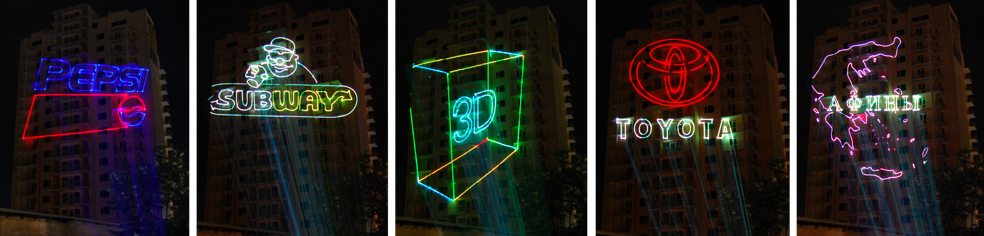
Choosing laser equipment for advertising
Do not select a projector solely from a quoted maximum distance such as 200 m, 700 m, 900 m or 2 km. Beam divergence, aperture, atmospheric conditions and the intended image size all affect image quality. A source with excessive divergence may produce a blurred image even at a relatively short distance. For a low-divergence system, distance alone still does not describe brightness or usable projection quality.
An essential question is: what image size and projection area will the system produce under the conditions at my site?
As the projected image becomes larger, the available optical power is spread across a larger drawing area and the display can become less visible. Output in milliwatts therefore needs to be assessed alongside image size, geometry, ambient light and surface properties. A low-cost projector that looks acceptable in a small demonstration may not provide a useful outdoor advertising image at the required scale.
What should you check when selecting an advertising projector?
Check total laser output in milliwatts and the allocation among red, green and blue sources. A quoted total can conceal a weak channel or an unbalanced image. The source article proposes comparing the weakest channel multiplied by three as one rough color-balance indicator. Perceived brightness is wavelength-dependent: green often contributes strongly to visual brightness, while simply increasing blue output does not guarantee a brighter balanced image. Excess blue may need to be reduced for color balance, lowering the practical output in the intended graphics.
In practice: The important comparison is usable output with the intended color balance, including a clean white, rather than an inflated sum of source ratings. Inspect actual projection examples for unwanted color casts, blur and poor text rendering. A high blue-channel rating alone is not enough to establish advertising performance.
What output is needed for outdoor advertising?
The answer depends on the target image area, surface material and color, ambient illumination and atmospheric losses from dust and moisture. A useful estimate should account for all of these. We can help calculate equipment requirements for your site. The following figures are the source article's illustrative minimum RGB output recommendations; they do not account for every surface or installation condition:
- 10–100 m²: at least 4,500 mW total output, including at least 1,000 mW green.
- 100–200 m²: at least 6,000 mW total output, including at least 1,200 mW green.
- 200–450 m²: at least 9,000 mW total output, including at least 2,000 mW green.
- 450–1,000 m²: at least 17,000 mW total output, including at least 4,000 mW green.
- 1,000–2,000 m²: at least 24,000 mW total output, including at least 6,000 mW green.
* These recommendations assume suitably high-quality sources and optics. The source article estimates that less efficient, higher-divergence systems may require around 2.5 times as much nominal output. This is a comparison assumption, not a specification that applies to every competing product.
For its intended outdoor advertising applications, the source article recommends output above 4,000 mW. Start by determining the maximum projection area and send us the site information by email or phone. We can propose a suitable model and estimate the required output. You can also compare the published specifications yourself. The article's area figures assume moderate background light, such as moonlight and nearby street lighting. Usable output, optical efficiency, aperture and divergence matter more than the nominal total alone.
How can you assess the quality of a projector's laser sources?
Look at aperture and beam divergence, not just output power. The source article favors 635 nm red and 532 nm DPSS green for the outdoor advertising configurations it describes, and discusses the larger fast-axis beam size of some 520 nm laser diodes. Its illustration shows an elongated beam spot that can blur fine graphics. Wavelength alone is not a complete specification: assess the actual source, corrective optics, divergence and projected image.
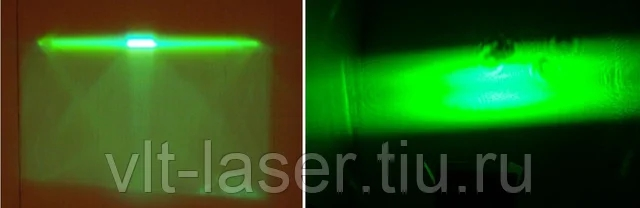
The author's recommendation for the configurations discussed is to use high-quality 532 nm DPSS green sources for large advertising displays, and to reserve the budget 520 nm LD systems for more limited applications. Raising nominal output to 2,000–3,000 mW does not by itself correct a large beam aperture or divergence. The article compares a working area above 10 m², a source life exceeding five years and 15,000 hours, and an illustrative price of about USD 40 for a 200–300 mW budget diode. These are model-specific and historical comparisons; compare current source specifications and a real projection demonstration rather than assuming every source at a given wavelength performs alike.
What is an advertising projector's service life?
A quoted 10,000-hour diode life is generally tied to specified source temperature, heat removal and current control, rather than guaranteed projector life under all conditions. The source article describes a 25°C target and a Peltier-based system controlled by a microprocessor using a separate sensor for each source, since the sources generate different amounts of heat.
In our service experience, some low-cost show projectors rely on a small fan rather than independent source temperature control. A unit intended for short shows may not tolerate advertising use for six to eight hours daily across varying weather conditions. Placing it in an inadequately ventilated enclosure can worsen overheating. The article quotes observed lives of 600–900 hours in unsuitable thermal boxes and up to 2,000 hours without them; these are the author's observations, not universal ratings for a country of manufacture.
Current stabilization and a controlled startup ramp also matter: a transient at power-on can damage a source. Developing our temperature-control design took more than five years. It uses Peltier elements in a protected optical compartment, providing both cooling and heating. Low ambient temperatures can also be harmful if a source is started abruptly, so cold-start protection prevents operation before the sources reach suitable conditions after a power interruption.
Our projectors use active and passive heating/cooling with continuous microprocessor monitoring and interlocks outside the permitted temperature range. Under documented conditions, sources have stated lives of 10,000 hours, with some models rated at 15,000 hours. Warranty periods for our own sources can extend to five years; confirm the terms for the selected equipment.
How can you assess an advertising projector's graphics performance?
Laser sources determine optical characteristics, while scanners steer a point to draw the image. Interpret scanner speed together with scan angle: a nominal 30 kpps rating at 5° may fall to around 15 kpps at a 30° working angle in the example discussed. If one word requires 1,200 points, 15,000 points per second divided by 1,200 points per frame gives 12.5 FPS. The article recommends at least 25 FPS for its intended advertising content. Actual point counts and usable frame rates depend on the artwork, optimization and scanner system.
Complex text is demanding because curved letters require many points. Adding more words can lower the refresh rate and increase visible flicker. Modulation and geometric linearity also matter; the article recommends checking modulation capability around 200 kHz for its intended graphics. It discusses DT-30/40-class scanners without the feedback or temperature stabilization required by the author's design expectations. Test the actual artwork rather than relying on a speed label alone.
Inadequate scanning performance can produce jitter, distorted shapes and broken lines. For demanding advertising graphics, the author recommends high-performance scanners, describing systems around 60–65 kpps or above at a 30° working angle and appropriate controller coordination. Less capable systems may be suitable for simple beam patterns but not for the intended complex text and animation. These figures are application recommendations, not a universal threshold for every laser graphic.
Why are the controller and software important?
The controller tells the scanners where to position the beam and coordinates the laser sources. Its resolution, timing and software integration therefore influence the accuracy and quality of the projected image.
We have encountered systems with serviceable scanners but poor graphics caused by a low-resolution controller. Higher DAC resolution allows finer positioning. Distinguish a full graphics controller with software and network functions from a basic SD playback device. An 8-bit DAC provides only 256 positions per axis, which can limit smooth curves and text; storing content on an SD card does not explain how that content is created or optimized. Assess the complete controller/scanner/software combination.
For detailed advertising graphics, the article recommends 12–16-bit DAC resolution per channel; a 16-bit coordinate range reaches 65,535 on each axis. VLT Laser uses Pangolin FB-4 and Moncha.Net controllers for the configurations described. The article quotes a historical price around RUB 50,000 for a controller and describes development of a VLT Laser STM++ controller with a 20-bit DAC per channel. Confirm current availability and included controller specifications.
The article highlights Pangolin QS, Moncha.Net and Pangolin Beyond. It describes the first two as included options with appropriate projector packages, while Beyond is separately licensed. These tools create animated content rather than only static frames and can optimize point counts for the scanner system. We also offer a converter and plugins for turning 3D Studio MAX animation into laser content; confirm the package and licensing available with your system.
Why can an unsuitable thermal enclosure cause problems?
A protective box cannot compensate for inadequate heat removal at the laser sources themselves. In hot conditions, an enclosure with insufficient heat dissipation can shorten source life or trigger faults. The article gives 300 W as an example enclosure rating, which must be compared with the actual equipment and ambient conditions. Our Termo projectors integrate Peltier-based heating/cooling, temperature monitoring and interlocks for cold starts and overheating. They generally need a suitable protective installation rather than an additional temperature-control box; an anti-vandal enclosure may still protect the equipment and electrical connections from access and precipitation.
What other functions are useful for advertising?
Remote content replacement is important when a projector is mounted on a roof, lighting pole or other difficult-to-access location. Wi-Fi, Ethernet or internet access lets you update content without physically replacing an SD card. Timed start/stop, remote commands and standalone playback avoid the need for a permanently connected computer. Verify temperature control at the sources themselves, not only the enclosure, and suitable protection after a power interruption. The essential optical, scanning and controller characteristics are discussed above.
What approvals and restrictions apply to outdoor laser advertising?
The source article discusses Russian certification documentation referring to GOST 31581-2012 “Laser safety. Requirements for the operation of laser products” and SanPiN 5804-91 “Rules for the design and operation of lasers”. It quotes possible penalties of RUB 500,000–3,000,000 for certain non-compliant use; this historical article is not a statement of current penalties or legal requirements for every installation. In addition to the relevant certification documents (laser safety documentation, not merely electrical safety documentation), obtain technical documentation and an equipment specification appropriate to the installation. VLT Laser supplies the documentation relevant to its products and can provide materials concerning Federal Antimonopoly Service conclusions for particular advertising arrangements. Whether a specific display requires permission must be established for the site and current local requirements; a supplier's document is not a universal exemption.
Example comparison: a budget projector marketed for advertising, examined here from the author's perspective as a beam-show system.
Listed source outputs: red, 638 nm, 300 mW; green, 520 nm, 200 mW; blue, 450 nm, 1 W.
Using the article's rough weakest-channel-times-three comparison, 200 mW green × 3 gives a 600 mW balanced-output indicator. This is not a direct measurement of total optical output.
The listed green source is 200 mW; the article's outdoor application example recommends at least 1,000 mW green.
The author's assessment is that this configuration is below the output and optical quality needed for the intended advertising installation, for which the article recommends at least 4,000 mW total output. The actual site and source characteristics must be evaluated.
The listing claims divergence below 1 mrad. The author questions whether this is supported by measurement and compares it with quoted values of about 0.8–1.1 mrad for high-end equipment such as KVANT LASER. Ask for measured data and the test conditions rather than accepting a marketing figure alone.
The listed blue source has five times the green source's output: 1 W equals 1,000 mW. The author identifies a risk of a blue color cast and poor balanced-white output. Inspect projected white, fine detail and color registration in an actual demonstration.
The scanner listing gives 50° and 30 kpps. In the article's working-angle example, a 1,200-point word is refreshed at about 12 FPS, producing visible flicker. The author also reports distorted or discontinuous lines and considers this configuration more appropriate for beam effects than detailed advertising graphics.
The examined system lacks independent source temperature stabilization and uses a fan. An unsuitable thermal enclosure could aggravate overheating. Electrical, ventilation and fire protection requirements must be assessed for the actual installation; do not assume that putting an indoor projector in a box makes it suitable for outdoor advertising.
The author's estimated life for the examined configuration is about 900 hours in an unsuitable thermal enclosure and 2,000 hours without it.
The examined unit uses an 8-bit SD playback device rather than the graphics controller expected by the author. An 8-bit DAC has 256 coordinate levels per axis, while a 16-bit range reaches 65,535. The listing also gives 10 kHz modulation; the author considers its overall graphics workflow inadequate for the intended 25–30 FPS advertising display.
The example includes software described as MediaLas Mamba for ILD beam-show content. The author reports limited optimization and scanner performance, identifying DT15 scanners rated around 15 kpps rather than the claimed 30 kpps. Separate advertised ranges of 500 m blue, 400 m green and 200 m red do not establish usable graphics quality or working area. Request a demonstration of your own intended content and confirm the actual included hardware/software versions.
The author's conclusion is to avoid buying equipment for advertising solely on price or nominal ratings. We regularly receive unsuitable systems for repair or proposed upgrades. Before paying, request an in-person demonstration of the intended graphics and verify the exact equipment, documentation, warranty and return terms. Rules for returns and technical goods depend on the contract and jurisdiction; do not assume a general 14-day return promise applies to a business equipment purchase.
Projection quality and the usable display scale are central to the proposed laser advertising business model, so choosing appropriate equipment is an important early decision.
Best regards, VLT Laser